The Lord's Prayer
 This is undoubtedly the most common prayer used by Christians. The event where prayer was given to us by Christ is recorded in the Gospel of Matthew 6:9–13 as a section of the Sermon on the Mount, and in the Gospel of Luke 11:2–4. Nowhere before this time did anyone dare to pray to God as their own father. It was not the custom of any rabbis or spiritual teachers to address the Almighty as "Abba," the way a child might use when speaking to their "Daddy". Jesus used it as an intimate form of address, then taught His disciples to do the same. The use of the prayer is a mark of being Christian.
As an indication of its importance, it is the prayer we pray just before receiving Holy Communion in the Divine LIturgy. Before we recite it the priest says, " And deem us worthy, O Master, that we may boldly, without condemnation dare to call upon thee, the Heavenly Father..." It is indeed most daring to address God as our father. It recognizes him above all else as our Creator and most loved Lord who will provide for and protect us. To say it requires a deep faith in God.
Prayer in Greek and English
Πάτερ ἡμῶν ὁ ἐν τοῖς οὐρανοῖς·
ἁγιασθήτω τὸ ὄνομά σου·
ἐλθέτω ἡ βασιλεία σου·
γενηθήτω τὸ θέλημά σου, ὡς ἐν οὐρανῷ καὶ ἐπὶ τῆς γῆς·
τὸν ἄρτον ἡμῶν τὸν ἐπιούσιον δὸς ἡμῖν σήμερον·
καὶ ἄφες ἡμῖν τὰ ὀφειλήματα ἡμῶν,
ὡς καὶ ἡμεῖς ἀφίεμεν τοῖς ὀφειλέταις ἡμῶν·
καὶ μὴ εἰσενέγκῃς ἡμᾶς εἰς πειρασμόν,
ἀλλὰ ῥῦσαι ἡμᾶς ἀπὸ τοῦ πονηροῦ.
Our Father, who art in heaven, hallowed be Thy name.
Thy Kingdom come, Thy will be done, on earth as it is in heaven.
Give us this day our daily bread;
and forgive us our trespasses
as we forgive those who trespass against us;
and lead us not into temptation,
but deliver us from evil.
Important Commentaries on the Lord's Prayer
Saint Gregory of Nyssa Five
Homilies on The Lord's Prayer
 Trans. by Theodore G. Stylianopoulos, 2003
Gregory of Nyssa (c 335 – after 394) was a Christian bishop and saint. He was a younger brother of Basil the Great and a good friend of Gregory Nazianzus. His significance has long been recognized in the Eastern Orthodox, Oriental Orthodox, and Roman Catholic branches of Christianity. Gregory along with his brother Basil of Caesarea and Gregory of Nazianzus are known as the Cappadocian Fathers.
Life of Saint Gregory
Introduction by T. G. Stylianopoulos
Homily 1 - Why we pray
"The present gathering needs to learn not only how to pray but that we must, by all means, pray. Perhaps, this has not yet been understood by many. For many in daily life have neglected and passed over this sacred and divine work of prayer. ..."
Homily 2 - Our Father Who Are In Heaven
"Do you see how much preparation we need? What quality of life? How much and what kind of diligence in order that our conscience rise to that level of confidence to dare address God as "Father?..."
Homily 3 - Hallowed Be Thy Name, Thy Kingdom Come
"Therefore, when I pray saving "Hallowed be Thy Name," the meaning of these words apply to me actualizing God's blessings. Lord, through the cooperation of Your help, may I become blameless, just and pious...."
Homily 4 Thy Will Be Done... Give Us This Day Our Daily Bread
"When therefore we stand to say to God "Thy Will be done also in me," it is entirely necessary first to condemn that manner of conduct which is lived outside the divine will and to fully own up to it in confession....
Homily 5 Forgive Us Our Debts As We Forgive Our Debtors...
"Do you see to what greatness the Lord exalts those who hear Him through the words of the prayer? He transforms human nature in some way to be closer to the divine..."
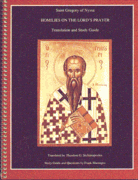 The texts above are take from the excellent study guide Saint Gregory of Nyssa's Homilies on the Lord's Prayer: Translation and Study Guide which is available from the Department of Education of the Greek Orthodox Archdiocese. See their catalog.
This excellent study guide includes the text of Saint Gregory's interpretation of the Lord's Prayer, a side-bar of scriptural, theological and ethical references useful in relating the meaning of the text to the reader's life experience, and study questions designed to promote faith-sharing discussions.
His Homilies are also available in St. Gregory of Nyssa: The Lord's Prayer, The Beatitudes which is part of the Ancient Christian Writers series.
Saint John Chrysostom on the Lord's Prayer
Homily 19 on St. Matthew- Chapter 6.
Trans. by Rev. Sir George Prevost, Bt., 1851
Rev. Am. ed. by Rev. Matthew B. Riddle, 1888
Saint John Chrysostom (c. 347–407, Greek: Ιωάννης ο Χρυσόστομος), archbishop of Constantinople, was an important Early Church Father. He is known for his eloquence in preaching and public speaking, his denunciation of abuse of authority by both ecclesiastical and political leaders, the Divine Liturgy of St. John Chrysostom, and his ascetic sensibilities.
"...neither should we make our prayers long; long, I mean, not in time, but in the number and length of the things mentioned. For perseverance indeed in the same requests is our duty..."
Saint Cyril of Jerusalem on The Lord's Prayer
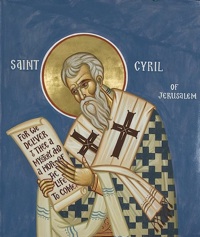 "O how immense God’s love is for men! To those who have gone far from him and fallen into the worst evil he grants so great a pardon for their sins and makes them share so greatly in his grace that they can call him “Father.”
Saint Cyprian on the Lord's Prayer
 "But let our speech and petition when we pray be under discipline, observing quietness and modesty. Let us consider that we are standing in God’s sight. We must please the divine eyes both with the habit of body and with the measure of voice."
Origen on the Lord's Prayer
 ...he shuts every door of the senses that he may not be held by the senses, or his mind glutted by their impressions. And he prays to the Father, who does not shun or abandon such a hidden place, but dwells in it together with the presence of His only Begotten Son. For He says, "I and the Father will come and make our home with him" (cf. Jn 14:23). It is obvious that if we pray in this way, we make our intercession with the Righteous One, who is not only our God, but also our Father, who does not abandon His sons, but is present with us in the secret place, observes it, and brings greater treasure into the "room", if we shut its door.
St. John Cassian on The Lord's Prayer
 "...when we say to him: 'Hallowed be thy name,' we are saying in other words: Make us such, Father, that we may deserve to understand and grasp how great your hallowing is and, of course, that you may appear as hallowed in our spiritual way of life. This is effectively fulfilled in us when 'people see our good works and glorify our Father who is in heaven.'"
Saint Germanus of Constantinople - Explantaion of the Our Father
We men are weak; therefore, it does not behoove us to fall into temptation, but rather to pray not to be overwhelmed by temptation. For he who is overwhelmed and overcome is led into the pit of temptation: but he who has fallen, has he prevailed?
Homily on the Lord's Prayer by by Archimandrite George, Abbot of the Holy Monastery of St. Gregoriou, Mount Athos
"This prayer is the pre-eminent prayer of the Church. In the daily Church services it is recited sixteen times, during Great Lent twenty-two times. Furthermore, it is, in a way, a summary of the Divine Liturgy."
Explanation of the Lord's Prayer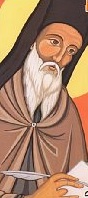 by St. Nikodemos the Hagiorite - An Excerpt from Concerning Frequent Communion
"It was mentioned above that no one should presumptuously and haphazardly partake of the Holy Bread and sacred Communion, without any preparation. For this reason the Lord now tells us through the Prayer that we must be reconciled with God and with our brothers before approaching the divine Mysteries, just as He says in another place: If thou bring thy gift to the altar, and there rememberest that thy brother hath ought against thee; leave there thy gift before the altar, and go thy way; first be reconciled to thy brother, and then come and offer thy gift ."
On the Lord's Prayer from the The Longer Catechism of The Orthodox, Catholic, Eastern Church also known as the Catechism of St. Philaret (Drozdov) of Moscow
How can God's Name be hallowed? "First, when we, having in our thoughts and heart the name of God, so live as his holiness requires, and thus glorify God; secondly, when others also, seeing our good lives, glorify God."
The Lord's Prayer
by A Monk of St. Tikhon's Monastery.
"In the fourth petition we beseech God to give us our daily bread everything we need in life, spiritual as well as physical. Our spiritual bread is the grace-bestowing Sacraments of the Church, instituted for our salvation. First and foremost, our daily bread means Holy Communion... Material bread means all that is necessary for human existence, directly associated with the surrounding world...."
Links on the Lord's Prayer